The Practical Guide to Understanding Glucose Patterns
A step-by-step guide to collecting, organizing, and discussing glucose patterns with enough context for careful, individualized interpretation.

Glucose data become useful when they answer a defined question. A meter value, sensor graph, meal note, symptom, or laboratory result each offers a different view, and none tells the entire story alone. Pattern review is the process of arranging comparable observations, checking their quality, adding relevant context, and deciding what questions to bring to a care team. It is not an invitation to chase every fluctuation or independently change treatment. This guide presents a practical workflow that can be adapted to paper logs, app records, or continuous glucose monitor reports. It emphasizes neutral language, selective data collection, device awareness, and the limits of inference. Glucose may be influenced by meals, activity, sleep, stress, illness, hormones, medicines, and measurement conditions; individual responses vary. Use the safety thresholds and actions in the personal care plan, and discuss individual goals with a qualified healthcare professional. Daily circumstances may influence what is practical, so a flexible plan should reflect the person's resources, preferences, and guidance from a qualified healthcare professional.
1. Begin with a precise monitoring question
A broad goal such as “understand my glucose” cannot determine what information to collect. A focused question might ask whether weekday morning values differ from weekend values, whether an alert occurs repeatedly during a particular shift, or why two reports appear inconsistent. The question should be clinically relevant, manageable, and reviewed with the care team when it would require measurements beyond the existing plan. Write it at the top of the log. This small step prevents a page of unrelated numbers from being mistaken for evidence and makes it easier to decide when enough information has been collected.
Clarify the purpose and time frame. Is the record supporting a routine visit, following a recent professional recommendation, documenting symptoms, or checking device performance? Each purpose needs different context. Do not increase testing frequency, change meal timing, or stage unusual activities merely to create a cleaner experiment without professional guidance. Monitoring has costs, physical burden, and emotional effects. A qualified healthcare professional can help choose a safe observation window, explain which situations require earlier contact, and identify when a different clinical test is more appropriate than additional home data.
2. Understand what each tool measures
A blood glucose meter generally measures glucose in a small blood sample at a selected moment. A CGM estimates glucose in interstitial fluid at frequent intervals and displays trends, but physiological lag and device conditions may matter, especially during rapid change. A1C reflects glucose attached to hemoglobin over a longer period and cannot show the timing of daily variation. These tools overlap but are not interchangeable. Apparent disagreement may arise because they sample different compartments, periods, and moments rather than because one result must be dismissed.
Use the instructions for the exact meter, strip, sensor, reader, or app. Hand preparation, sample size, strip storage, sensor startup, pressure on a sensor, adhesion, signal gaps, and report completeness may affect data quality. Learn when the specific device calls for confirmation and what to do when symptoms do not match the display. Record technical problems instead of silently deleting inconvenient values. If equipment repeatedly behaves unexpectedly, involve the manufacturer and care team. Device troubleshooting should support safety, not become a way to explain away every surprising observation.
3. Build a minimal, consistent record
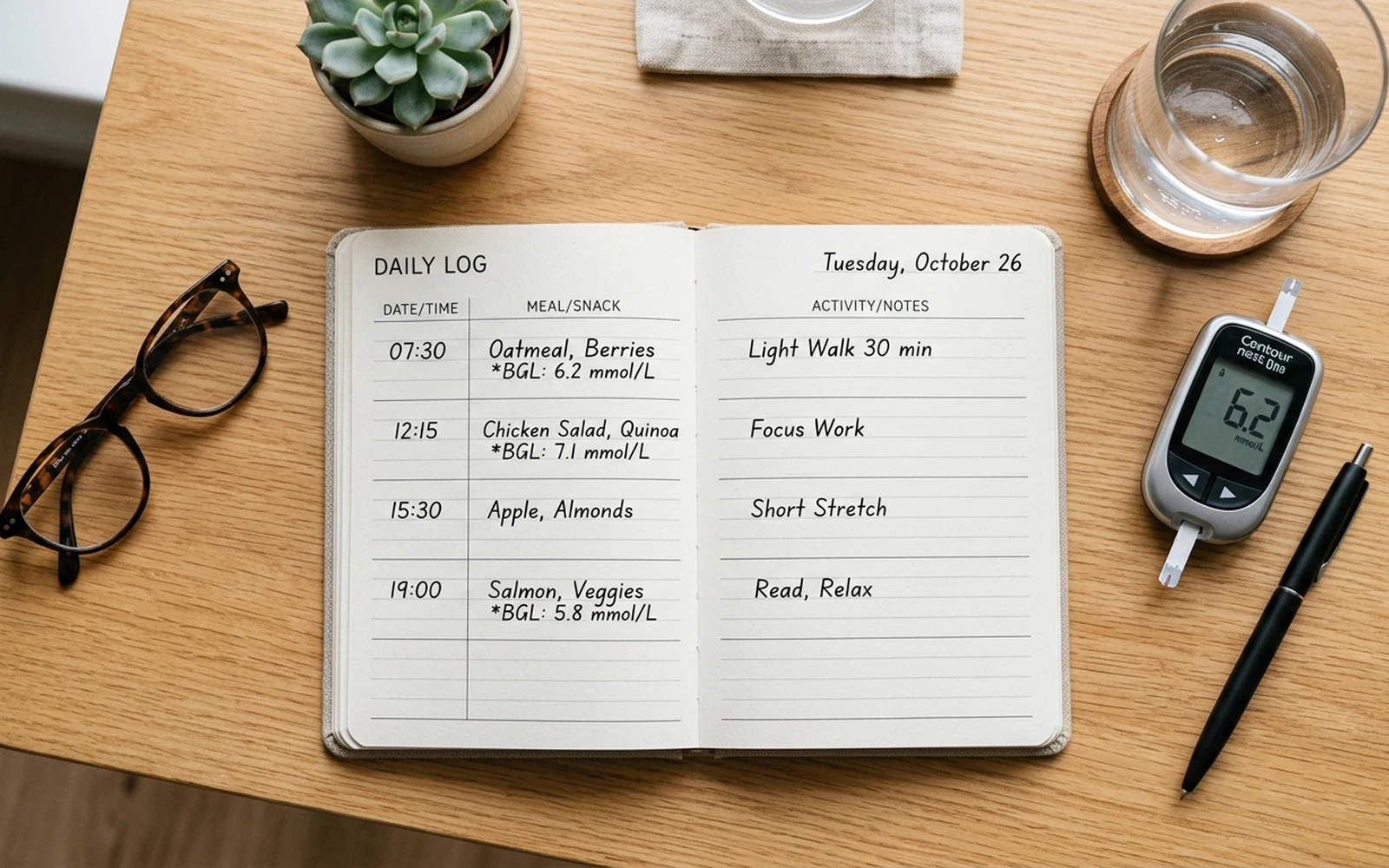
For selected meter checks, record date, clock time, value, measurement method, and the intended label, such as fasting, before meal, after meal, symptoms, or activity. When a check relates to food, identify the meal start or use the timing convention supplied by the care team. For CGM, use downloaded reports rather than copying hundreds of values, and add concise event notes only where they inform the question. A minimal record is more likely to remain accurate than a complicated form filled in from memory days later.
Context should be selective. Approximate meal components, unusual activity, disrupted sleep, illness, stress, menstrual-cycle context, travel, or a new medicine may be relevant, but not every factor belongs on every line. A note such as “later meal during travel” is often enough. Keep a complete medicine and supplement list separately and report changes to the clinician. Protect privacy by using a secure app or storing paper records appropriately, especially when workplace, family, or shared-device access could expose health information.
4. Compare genuinely similar situations
Group observations by the question they can answer. Morning fasting checks should not be blended with after-dinner checks merely because both are high or low relative to expectation. After-meal comparisons need consistent timing, and CGM segments should be aligned to meaningful events rather than arbitrary screenshots. Weekdays, weekends, shift work, travel, and illness may belong in separate groups. Similarity will never be perfect; the goal is enough consistency to avoid obvious mismatches and enough context to explain remaining differences.
Look for recurrence, duration, and exceptions. How often does the feature appear? Does it occur at roughly the same time? What happens on days when it does not appear? An exception can reveal that the proposed pattern is actually a timing artifact or that an important context variable is missing. Avoid choosing only dramatic examples. Include the full agreed observation window, data gaps, and ordinary days. A pattern is stronger when it survives honest inclusion of observations that do not support the first theory.
5. Use neutral description before interpretation
Write a factual summary before proposing explanations: “Across eight workdays, the sensor trace rose after the evening meal on six days; meal times varied by about an hour, and two days included walks.” This statement shows what was observed and where the comparison is limited. In contrast, “carbs caused bad numbers” compresses several assumptions into moral language. Neutral summaries reduce shame and give the care team room to consider food, timing, activity, sleep, treatment, device factors, and normal variability.
Distinguish association from cause. A stressful meeting can occur before an unusual reading without proving that stress produced it. A walk can precede a different pattern without establishing that the walk is solely responsible. Glucose is a dynamic outcome with multiple influences, and home observations rarely control all variables. This does not make logs useless; it defines their best use. They generate informed clinical questions and can show repeated circumstances, while diagnosis and treatment decisions require professional judgment and sometimes additional testing.
6. Apply a safety filter before analysis
Pattern work is for situations in which it is appropriate to pause and review. Symptoms or values that meet urgent criteria in the personal care plan require the specified response first. Follow instructions for rechecking, using backup equipment, contacting the team, or seeking urgent help. Do not wait to gather several examples when the plan says to act now. General educational material cannot supply universal thresholds because risks, medicines, pregnancy, age, and health history differ widely.
Avoid self-directed corrections based on a graph. Do not skip meals, add strenuous exercise, take extra medicine, or alter treatment because a pattern seems obvious. Even a real pattern can have several explanations and may require information that is not visible in the log. If anxiety leads to repeated checking, inability to sleep, food avoidance, or constant graph watching, tell the care team. Monitoring burden and diabetes distress are legitimate clinical concerns, and a simpler plan or additional support may be appropriate.
7. Turn the pattern into a care-team conversation
Prepare a concise package: the monitoring question, date range, method, neutral pattern summary, relevant context, exceptions, symptoms, device issues, and two or three questions. Attach the underlying log or report so the clinician can verify the summary. State what you are not sure about. For a message, include enough information for safe triage but use the clinic's approved channel rather than ordinary email or social media. Ask when a response should be expected and what to do if the situation changes.
During review, ask how confident the team is that the pattern is meaningful, what alternative explanations remain, and whether any additional observation is needed. Confirm the next step in plain language, including what stays unchanged, how long to continue the plan, and when to follow up. Individual responses vary, so discuss individual goals with a qualified healthcare professional. A successful review is not necessarily a changed treatment; it may produce reassurance, better technique, a refined question, fewer unnecessary checks, or a clearer safety plan.
Questions for Your Care Team
These prompts are for a conversation with a qualified healthcare professional. They are not instructions to change a personal care plan.
- What single monitoring question would be most useful for us to answer with my current device and care plan?
- Which timing labels, context fields, and observation period will make the comparison meaningful without creating unnecessary burden?
- What device differences, health factors, or alternative explanations should we consider before interpreting the apparent pattern?
- Which findings require immediate action, which warrant a message, and which can safely wait for our planned review?
Sources
GlucoContext prioritizes authoritative United States health organizations and peer-reviewed research. External pages are controlled by their publishers.