The Complete Guide to Reading Nutrition Facts Labels
A complete, practical guide to serving size, carbohydrates, sugars, fiber, fats, sodium, ingredients, claims, and side-by-side comparisons in everyday context.

The Nutrition Facts label turns a packaged food into a set of comparable facts, but it works only when the reader connects every number to serving size. For carbohydrate awareness, Total Carbohydrate is usually more informative than sugar alone because it includes sugars, starches, and dietary fiber. A complete review also considers protein, fat, sodium, ingredients, allergens, and the food's role in a meal. Front-of-package claims can be useful clues, yet they never replace the required panel. This guide offers a repeatable reading order, explains common calculations, and shows how to compare products without searching for a universally perfect food. Labels describe the product, not an individual's likely glucose response. Food form, portion, meal composition, activity, sleep, stress, medicines, and other factors may influence what happens. Individual responses vary, and people should discuss individual goals with a qualified healthcare professional or registered dietitian.
1. Orient yourself to serving information
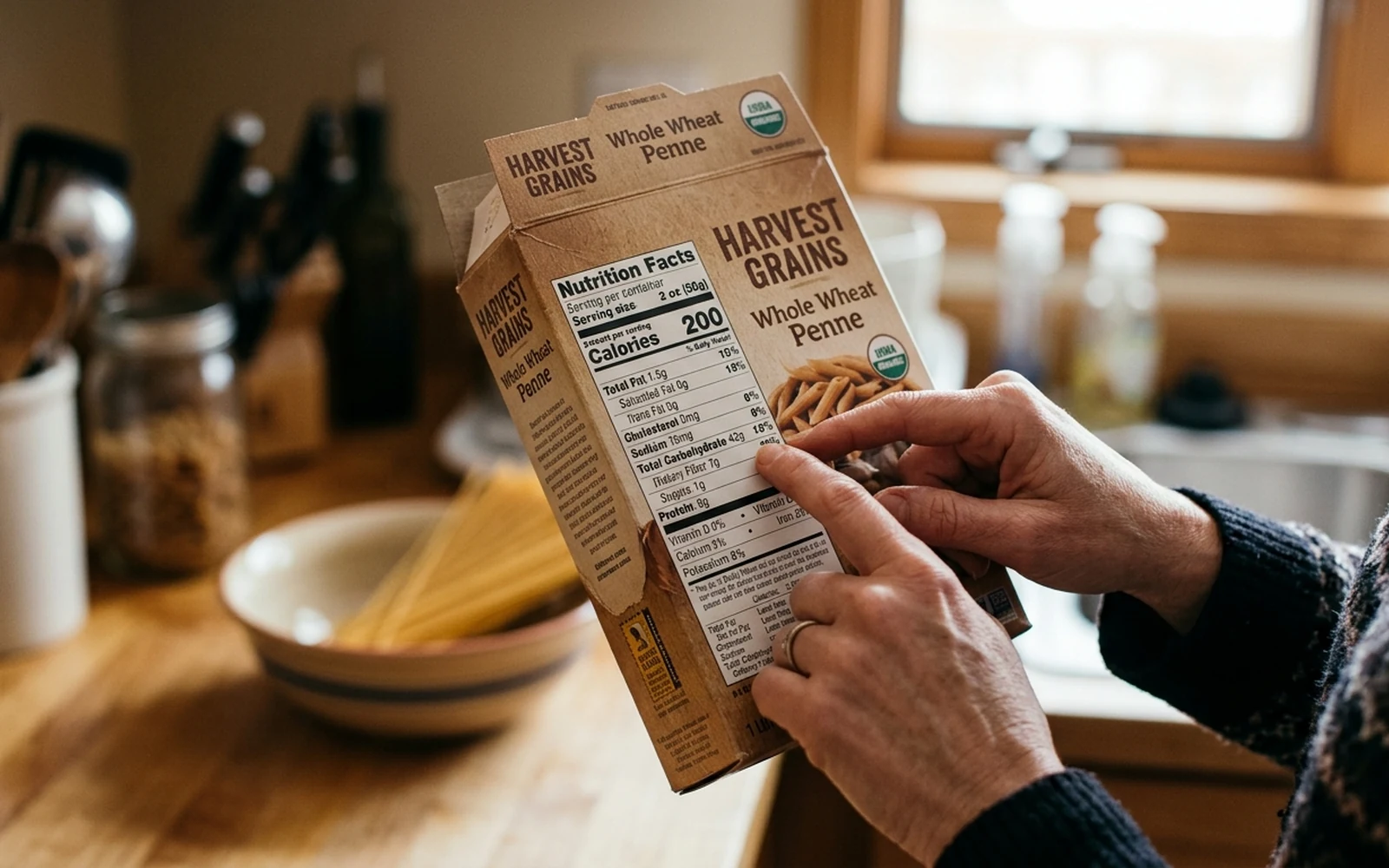
Serving size appears at the top and uses a familiar measure, such as cups or pieces, alongside a metric weight or volume. Every calorie and nutrient value below applies to that amount unless a second column says otherwise. Servings per container tells how many labeled portions the package contains. The serving is designed to reflect customary consumption under labeling rules; it is not a prescription for how much a particular person should eat. Begin every reading by saying, “These numbers describe this amount,” and compare that amount with the portion you expect to use.
Packages that may be eaten in one sitting sometimes show both per-serving and per-container columns. When only one column appears, multiplication or division may be needed. If a package has two servings and the whole package is eaten, multiply each relevant nutrient by two. If half a serving is used, divide by two. Keep units consistent: grams of food are not the same as grams of carbohydrate, and a household cup may not match the package's weight without product-specific information. Honest estimates are preferable to false precision.
2. Read Total Carbohydrate as the umbrella
Total Carbohydrate is listed in grams and includes dietary fiber, total sugars, and starch. Fiber and sugars appear as indented lines; starch often does not have a separate required line. This is why a cracker can contain substantial carbohydrate despite listing little sugar. For a person using carbohydrate information in a care plan, the total line usually supplies the broad starting value. Percent Daily Value is a population reference based on a standard daily intake and should not be mistaken for an individualized carbohydrate target.
When the portion differs, adjust the total carbohydrate using the same proportion as the serving. For one and a half servings, multiply by 1.5; for three-quarters, multiply by 0.75. A calculator is reasonable, and rounding can reflect the accuracy of the portion estimate. Record the serving and calculation if discussing it with a clinician. Do not apply online subtraction formulas for fiber or sugar alcohols automatically. Products and care methods differ, and a qualified professional should explain whether such details are relevant for the individual.
3. Understand fiber, total sugars, and added sugars
Dietary fiber is carbohydrate that is not fully digested, and different fibers have different physical properties. The label reports grams per serving and a Percent Daily Value. Fiber-rich foods can support digestive and cardiovascular health and may influence fullness or the timing of digestion, but added fiber does not turn every product into a balanced choice. Sudden increases may cause discomfort for some people, and kidney, gastrointestinal, swallowing, or fluid considerations may require individualized advice.
Total Sugars includes naturally occurring and added sugars. Includes Added Sugars identifies the amount added during processing and sits within Total Sugars; it should not be added again to the carbohydrate calculation. A product can contain zero added sugar and still contain natural sugar, starch, or both. Conversely, a product with added sugar may still contribute other useful nutrients. These lines answer source and quantity questions, not whether a food is morally good or guaranteed to produce a particular glucose response.
4. Look beyond carbohydrate when the goal requires it
Calories describe energy in the labeled serving. Protein contributes amino acids and may affect meal satisfaction, but protein needs vary. Total Fat is divided into saturated fat and trans fat, with other fats included in the total even when not separately named. Sodium may be important for cardiovascular, kidney, or other care. Vitamins and minerals listed at the bottom highlight selected nutrients. A useful comparison chooses the few fields connected to the person's goals instead of judging a product by every number simultaneously.
Food decisions also depend on the complete meal. A bread lower in carbohydrate but unacceptable in taste may not replace a familiar bread successfully. A canned soup higher in sodium might be used less often, diluted with other ingredients, or selected because it is affordable and accessible. These are planning questions, not automatic rules. A registered dietitian can help weigh nutrients when priorities compete, particularly when diabetes overlaps with kidney disease, heart disease, digestive conditions, food allergies, pregnancy, or inadequate intake.
5. Use the ingredient list and allergen information
Ingredients are listed in descending order by weight. The list can identify whole grains, types of oil, sweeteners, legumes, additives, and other components, but it cannot replace the measured nutrient amounts. Multiple sweeteners may appear under different names, yet Added Sugars provides the standardized quantity. The first ingredient may offer a clue about the product's foundation, but a single ingredient does not summarize nutrition, processing, environmental impact, taste, or how the food will be eaten.
People with food allergies need the product's allergen labeling and their medical plan, not a general diabetes rule. Formulas can change, so read the package each time rather than relying only on a previous purchase or an online image. Advisory statements and cross-contact questions may require manufacturer information. Ingredient lists also matter for religious, cultural, vegetarian, or digestive preferences. If a term is unfamiliar, consult the manufacturer or an authoritative source instead of assuming that unfamiliar means unsafe.
6. Verify front-of-package claims
Claims such as sugar free, no added sugar, reduced sodium, low fat, high fiber, natural, plant based, or keto highlight selected features and follow different definitions or, in some cases, have no single nutritional meaning. Turn the package around. Confirm serving size, Total Carbohydrate, relevant nutrients, and ingredients. “No added sugar” does not mean carbohydrate free; “multigrain” does not establish that whole grain is the primary ingredient; and a product marketed for diabetes does not automatically fit every person's needs.
Health-related language can also create a halo that makes portions or other nutrients easy to overlook. Compare the claimed product with the regular version at equivalent amounts. A reduced claim describes a difference from a reference food, not an absolute amount. Ask whether the changed feature matters for the intended meal and whether cost or taste changes. Be especially cautious with products promising rapid or certain health outcomes, and review supplements or concentrated products with the care team and pharmacist.
7. Compare products in a repeatable order
First align serving sizes. If two cereals list different gram weights, calculate an equivalent amount or consider the portion normally eaten. Second compare Total Carbohydrate and the subcomponents relevant to the question. Third review protein, fat, sodium, or other priorities. Fourth scan ingredients and allergen information. Finally include price per usable portion, package size, storage, preparation, taste, and availability. This order prevents a striking front claim or one favorable nutrient from deciding the comparison before the products are placed on equal terms.
The result may be a tradeoff rather than a winner. One option may have more fiber, another less sodium, and a third a lower price or preferred flavor. The intended use matters: a plain yogurt for a mixed breakfast is not evaluated like a dessert eaten occasionally. Write down why the selected feature matters to the care plan. Individual responses vary, so discuss individual goals with a qualified healthcare professional rather than treating a side-by-side label exercise as a clinical verdict.
Questions for Your Care Team
These prompts are for a conversation with a qualified healthcare professional. They are not instructions to change a personal care plan.
- Which Nutrition Facts fields should I prioritize given my health history, current treatment, and usual meals?
- How should I handle fiber, sugar alcohols, or unusually small serving sizes within the planning method you recommend for me?
- Can we compare the actual portions of two products I buy and identify where my estimate is most uncertain?
- Are any ingredient, allergen, kidney, digestive, sodium, or medication considerations especially important in my situation?
Sources
GlucoContext prioritizes authoritative United States health organizations and peer-reviewed research. External pages are controlled by their publishers.